
AI Body Analyzer vs X-ray: What’s the Real Difference?
A Practical Guide for Fitness & Wellness Distributors
When discussing posture assessment and body analysis,
a common question often comes up:
“What’s the difference between an AI Body Analyzer and an X-ray?”
While both are used to understand the human body,
they serve fundamentally different purposes and operate in completely different environments.
In this article, we’ll break down the key differences—especially from a commercial and operational perspective.
1. Different Technologies: Radiation Imaging vs AI-Based Analysis
An X-ray is a medical imaging tool that uses radiation to capture internal skeletal structures.
It is typically used to examine:
- Spine alignment
- Bone structure
- Disc conditions
X-rays are essential for clinical diagnosis and medical decision-making.
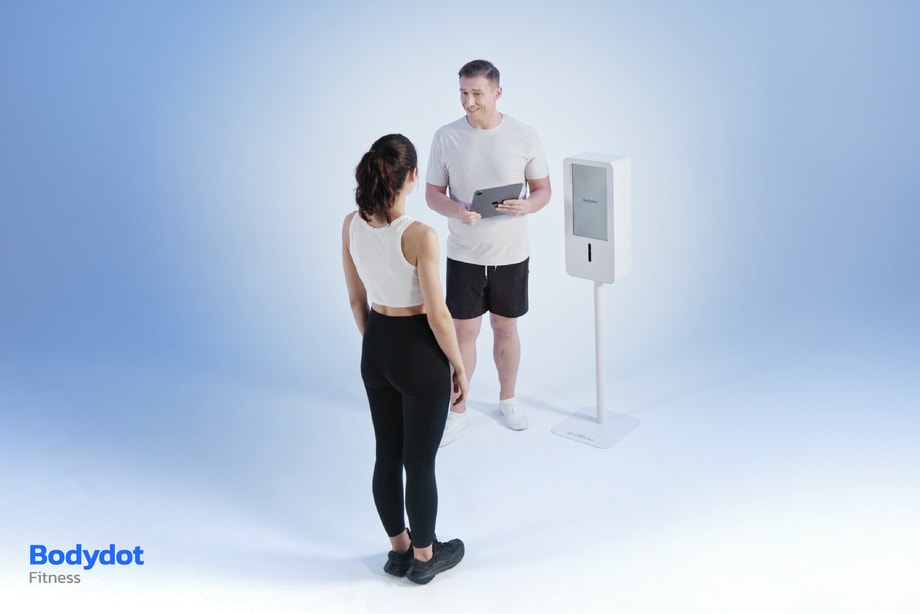
On the other hand, an AI Body Analyzer, such as Bodydot, uses AI and 3D camera technology to analyze the body externally.
It evaluates:
- Posture alignment
- Joint positioning
- Body symmetry
- Movement patterns
In simple terms:
- X-ray → Internal structure (diagnosis)
- AI Body Analyzer → External structure and movement (functional analysis)
2. Safety & Frequency of Use
This is one of the most critical differences in real-world applications.
X-rays involve radiation exposure, which means:
- Limited frequency of use
- Higher operational costs
- Not suitable for routine or repeated assessments
In contrast, an AI Body Analyzer (Bodydot) is:
- Non-invasive
- Radiation-free
- Safe for frequent use
This makes it ideal for:
- Tracking progress over time
- Before-and-after comparisons
- Daily or weekly assessments in fitness environments
3. Purpose: Diagnosis vs Coaching & Engagement
The core purpose of each technology is fundamentally different.
X-ray → Medical Diagnosis
- Identifying structural abnormalities
- Supporting treatment planning
- Used in hospitals and clinics
AI Body Analyzer → Coaching & Communication
- Visualizing posture issues
- Helping clients understand their body
- Supporting trainers in consultation and sales
For example, instead of just explaining a problem, trainers can show:
- “Your pelvis is slightly tilted like this”
- “This is your forward head posture angle”
This transforms data into a visual, persuasive experience.
4. Practical Use in the Field
From an operational standpoint, the difference becomes even clearer.
X-ray
- Requires medical facilities
- High installation and regulatory barriers
- Not suitable for gyms or studios
AI Body Analyzer (Bodydot)
- Designed for gyms, Pilates studios, and PT centers
- Easy to install and operate
- Fast measurement (typically within seconds)
- Enhances customer experience
In short:
X-ray is a clinical toolwhile an AI Body Analyzer is a commercial and operational tool.
5. Which One Is Better?
This is actually the wrong question.
These technologies are not competitors—they serve different roles.
- X-ray → Diagnosis
- AI Body Analyzer → Assessment + Coaching
Many advanced ecosystems use both, but in different contexts.
Conclusion: Two Tools, Two Markets
The key takeaway for distributors is clear:
- X-ray → Medical market
- AI Body Analyzer (Bodydot) → Fitness & wellness market
And more importantly:
An AI Body Analyzer is not just a measurement device—it is a conversion and engagement tool.
By helping clients see and understand their body,
it directly contributes to:
- Higher PT conversion rates
- Better client retention
- Stronger coaching effectiveness