Hello, this is Team Elysium.
There is one question we hear most often from centers using Bodydot for the first time.
“I measured the member’s posture, but all the results came back within the normal range. How should I approach the consultation?”
Another common question is:
“I compared the Before & After results, but some of the measurements have actually gotten worse. How should I explain this to the member?”
These situations may seem confusing at first, but both can occur quite commonly.
Today, we’ll introduce how to interpret the Bodydot body analysis report, one of the topics covered most frequently in Bodydot training.
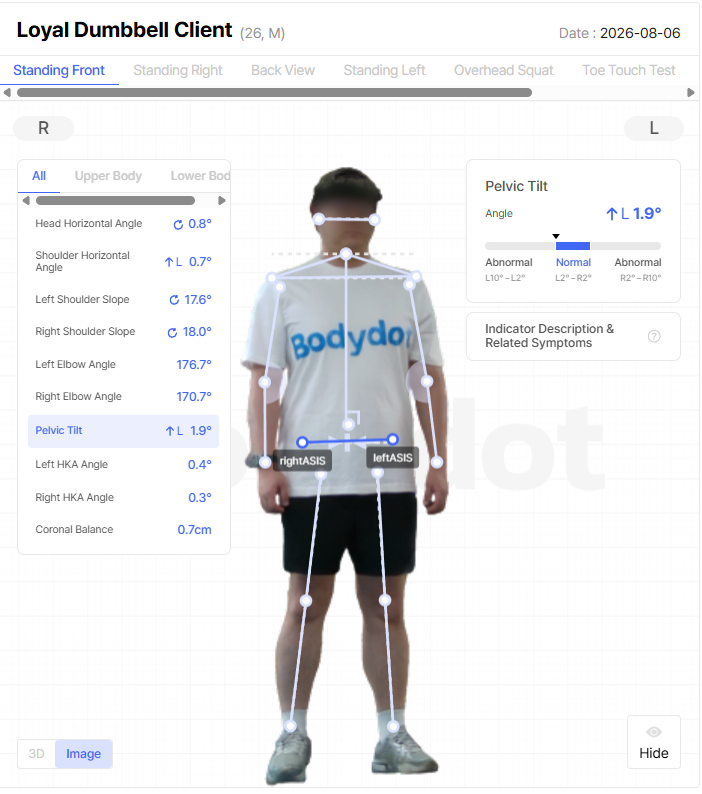
Q. I measured the member’s posture, but all the results are within the normal range.
First, let’s consider one question.
Why do we measure posture and body alignment?
Many people might say:
- To assess posture
- To analyze body alignment
- To provide a consultation
And all of these are valid reasons.
However, one important purpose is to understand a member’s current physical condition and help prevent potential imbalances or injuries in the future.
So, there is no need to be concerned when all the results fall within the normal range.
Being Within the Normal Range Doesn’t Mean the Body Is Perfectly Balanced
Even someone who does not exercise regularly may fall within the normal range if they have good everyday habits or relatively good posture.
In these cases, it can be helpful to look at overall tendencies.
For example:
The right shoulder is slightly higher,and the right side of the pelvis is also slightly elevated.
Even when measurements fall within the normal range, very few people have a body that is perfectly symmetrical.
Therefore, rather than ending the consultation with,
“Everything is normal.”
it is more helpful to explain which direction the body may be compensating toward, such as:
“Your measurements are currently within the normal range, but your body’s center is slightly shifted to the left.”
This allows members to understand their bodies more easily and naturally recognize what areas they may want to focus on going forward.
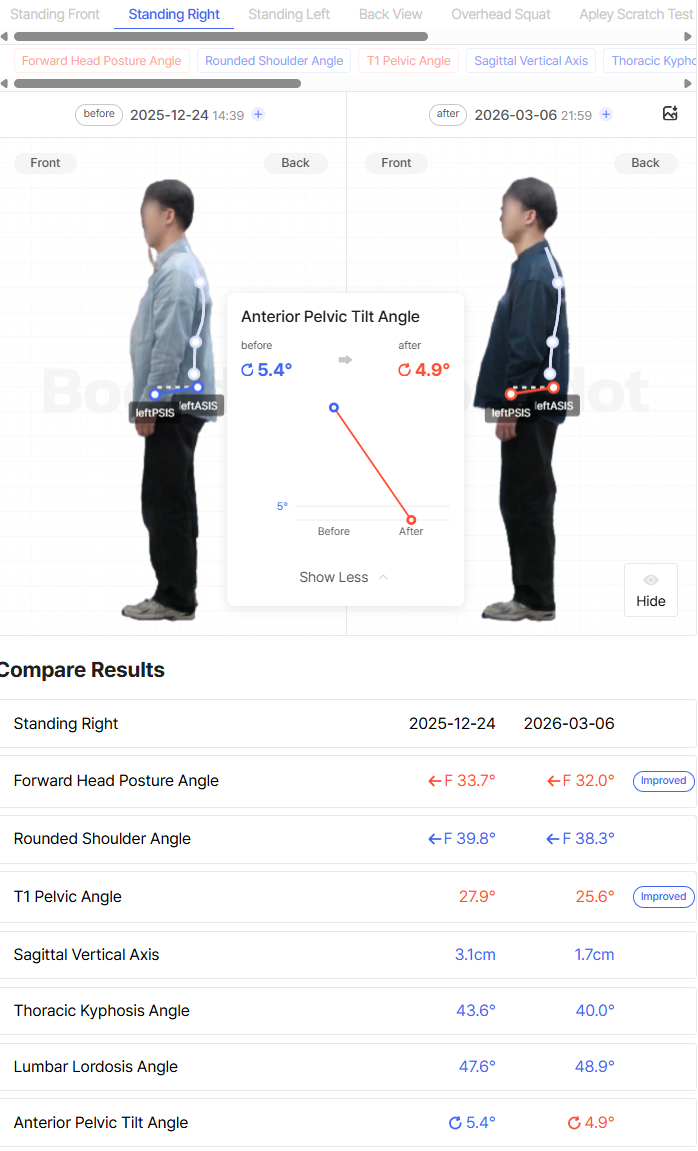
Q. I compared the Before & After results, but some of the measurements have actually gotten worse.
This is another question we hear very often.
To put it simply, this can be a normal part of the process.
Our bodies do not become perfectly balanced after a single workout or session of care.
Instead, like a seesaw moving from one side to the other, the body may shift in one direction, then compensate in the opposite direction, gradually working toward a new balance.
In other words, not every measurement improves at the same time.
Some areas may adapt and improve first, while others may take longer to follow.
So, if some measurements temporarily worsen, it does not necessarily mean that the body has become worse.
It can instead be understood as part of the body’s process of adapting and finding a new balance.
What Matters Is Not a Single Result, but the Trend Over Time
Posture is not created in a single day.
Our current posture is shaped by long-term habits and movement patterns, so it is natural for changes to occur gradually over time.
That is why Bodydot places greater value on continuously recording and comparing data to track changes in the body, rather than focusing on a single measurement.
When consulting with a member, instead of simply saying,
“This measurement has changed a little today.”
it is much more meaningful to explain:
“Let’s look at the direction your body has been changing compared to where you started.”
This approach can help members better understand their progress and build greater trust in the consultation process.
No more guessing. Know your body.