.png)
Why 3D Body Scanning Is Transforming Fitness Studio Consultations
Have you ever heard this at the end of a consultation?
"I'll think about it and get back to you."
If you run a fitness or Pilates studio, you know exactly how that feels. Whether a new visitor signs up for personal training almost always comes down to that first consultation — the Orientation Training (OT) session. Yet most studios still rely entirely on verbal explanations and the trainer's personal experience.
This article explores how 3D body scanning is changing the quality of OT consultations, and why that directly improves PT conversion rates and member retention.
Why the First Consultation Matters More Than You Think
OT is not just a facility tour. It's the moment a prospective member decides: "I can trust this studio. I can trust this trainer."
From the experience of fitness professionals across the industry, the decision to enroll in personal training is effectively made during the initial consultation. The critical variable is whether the member directly recognizes their own physical issues — or only has a vague, uninformed sense of them.
So the real question is: is the way you're running OT consultations today actually effective?
The Limits of Traditional OT Consultations
Most OT sessions follow a familiar pattern:
- A trainer looks the client over visually and explains what they see verbally
- "Your shoulders are rolling forward a bit," "Your hips seem slightly tilted"
- The client nods — but has no real sense of how much, or why it matters
This approach has three structural problems.
First, consultation quality depends entirely on the individual trainer. A trainer with ten years of experience and a newcomer will deliver completely different OT sessions. Maintaining consistent quality across your studio is nearly impossible.
Second, verbal explanations simply aren't persuasive enough. "Your shoulders are rounded" is an observation, not data. If a member can't clearly see and understand their own physical problems, they won't feel the need for PT — no matter how compelling your pitch.
Third, there's no baseline to track progress. Three or six months later, when you want to show a member how much they've improved, there's nothing to compare against. You've lost your most powerful tool for driving renewals before the session even begins.
How 3D Body Scanning Changes Everything
3D body scanning addresses all three of these problems at once.
An Objective, Data-Rich Report — Ready in 60 Seconds
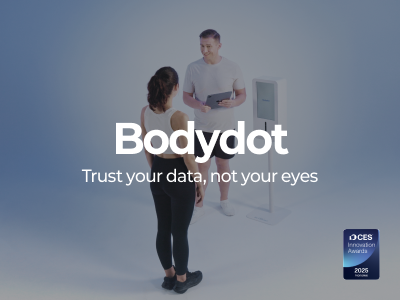
The member steps in front of the camera, and within one minute, a full body analysis is complete. Forward head posture angle, shoulder height asymmetry, pelvic tilt, knee alignment — 40 separate metrics are measured and displayed in a visual report, generated instantly.
Instead of "your shoulders are rolling forward," the report shows the exact degree of asymmetry, whether the cervical angle falls outside the normal range, and precisely where the body is misaligned. When clients see that, their expression changes.
A Consultation Where the Client Sees for Themselves
The report is visual. When a client's posture is mapped onto a 3D model in real time, they understand the problem without needing the trainer to explain it. The nature of the consultation shifts from "convincing the client" to "looking at the data together."
You don't need to sell. The data speaks. The client draws their own conclusions.
Closing the Trainer Skill Gap
Because the data-driven report forms the backbone of every consultation, even a less experienced trainer can deliver a structured, professional OT session. Consultation quality becomes consistent across your entire studio — reducing your dependence on any single trainer's skills or intuition.
What Changes After Implementation
Higher PT Conversion Rates
When a member sees their physical condition in numbers, the conclusion — "I need personal training" — comes from them, not from you. Trainers shift from salespeople to partners: "Let's work on this together." Enrollment becomes a natural next step, driven by trust rather than persuasion.
Before/After Data That Drives Renewals
The measurements taken during OT become the baseline for comparison three or six months later. Showing a member concrete progress — "your forward head angle has improved" — is the most powerful argument for renewal. It's not just a revenue tool; it builds lasting trust that keeps members coming back.
Extending Consultations Online
Bodydot's web-based software allows the measurement and consultation rooms to operate independently, and supports remote consultations as well. Sharing a body analysis report with a prospective member before they visit the studio can increase the rate at which online inquiries become in-person appointments.
At a Glance
Traditional OT | With 3D Body Scanning |
Trainer's visual assessment | AI-powered analysis across 40 metrics |
Verbal, subjective explanation | Numeric + visual report (objective) |
Quality varies by trainer | Consistent consultation quality |
No way to track change | Before/After data stored automatically |
Weak case for renewal | Data comparison drives re-enrollment |
Closing
The initial consultation is your studio's first impression. When that impression speaks in data, member trust is a different thing entirely.
Backed by over 80,000 body analysis records and a 97.0% accuracy rate, Bodydot earned the CES 2025 Innovation Award in the Fitness category — recognition that the technology holds up.
From OT to PT enrollment to long-term renewal — it's time to build a studio where data connects every step.