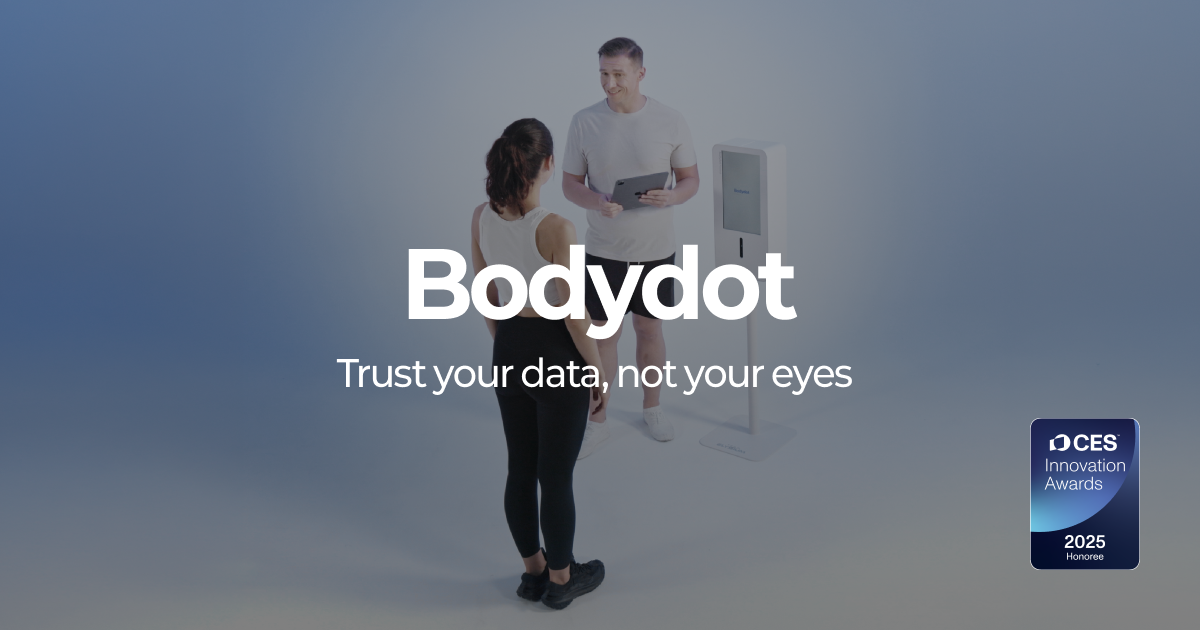
The best body analyzer for a Pilates studio is one that measures posture and alignment — not just body composition — quickly, visually, and consistently enough to track a client's progress from session to session.
Why Pilates studios need a different kind of analyzer
Pilates is built around alignment, symmetry, and control. Clients come in because their shoulders are uneven, their pelvis tilts, or their back hurts — and what they want to see is whether that is actually changing. A device that only reports weight, body fat, and muscle mass answers a different question. It can be useful, but it doesn't show the thing Pilates is designed to improve.
Five things to look for
1. It measures posture and alignment, not just composition.
Look for measurements that match what you actually correct in class: forward head posture, rounded shoulders, pelvic tilt, left-right balance, and leg alignment.
2. The results are visual.
Clients understand an image of their own posture far faster than a table of numbers. A visual report makes it easier to explain why a program is needed.
3. It's consistent enough to compare over time.
The real value is the before-and-after. If results shift depending on who takes the measurement, comparisons stop being meaningful.
4. It's fast enough for a real session.
If a scan takes a big chunk of an intro session, it won't get used consistently. A measurement that takes seconds fits into every first visit and every re-check.
5. It fits a studio space.
Most Pilates studios don't have room to spare. Check the footprint and how much distance the measurement needs.
The main options, compared
Option | Posture & alignment | Visual report | Consistency over time |
Visual assessment by instructor | Yes, but subjective | No | Varies by instructor |
Body composition analyzer | No — measures fat, muscle, water | Numbers and graphs | Affected by hydration, meals, time of day |
AI + 3D body analyzer, e.g. Bodydot | Yes — 40 measurement items | Yes — images, angles, alignment data | Same AI standard every time |
A body composition analyzer isn't the wrong tool — it just answers "what is the body made of," while Pilates mostly asks "how is the body aligned." Many studios use both.
How Bodydot measures up
What to look for | Bodydot |
Posture & alignment | 40 measurement items, including forward head posture, rounded shoulders, pelvic tilt, left-right balance, and leg alignment |
Visual results | Visual report with images, angles, and alignment data |
Consistency | AI model trained on 165,000+ musculoskeletal data points, 97.0% accuracy |
Speed | About 30 seconds from scan to exercise prescription |
Space | 500 × 500 mm floor footprint, about 1.5 m between client and device |
Client comfort | Non-contact — no need to remove shoes or change clothes |
It also generates an exercise prescription from each client's results, which gives instructors a starting point for programming — not a replacement for their judgment.
When you might not need one yet
If your studio mainly runs group mat classes with little one-on-one assessment, or if clients rarely come in with posture or pain concerns, a dedicated body analyzer may not be your first priority. It pays off most in studios built around private sessions, rehab-oriented clients, and programs where showing progress drives renewals.
FAQ
What should a Pilates studio look for in a body analyzer?
Posture and alignment measurements, visual results, consistency across repeat scans, a quick measurement time, and a footprint that fits the studio.
Is a body composition analyzer enough for Pilates?
Usually not on its own. It measures fat, muscle, and water, while Pilates focuses on posture and alignment — many studios use both.
How long does a Bodydot scan take?
About 30 seconds, from scan to exercise prescription.
Do clients need to change clothes or remove shoes?
No. Bodydot is non-contact, so clients can be scanned as they are.
How much space does it need?
A 500 × 500 mm floor footprint, with about 1.5 m between the client and the device.
Bottom line
For a Pilates studio, the right body analyzer is the one that shows what Pilates actually changes: posture, alignment, and balance — clearly enough for clients to see it, and consistently enough to prove progress over time. Use the five criteria above to compare any option, including Bodydot.