Every center uses its body analyzer differently.
Some use it during the first consultation to show new members their current condition,
while others measure members all at once during an opening event.
The same equipment can serve completely different purposes depending on when, for whom, and why you measure.
In this article, we look at how to use a body analyzer from the perspective of re-measurement and member record management.
Using data and real cases, we'll explore how centers re-measure members they've already assessed
and build those records into their member management.
We analyzed 18 weeks of usage data (June 1 – October 4, 2026) from centers using Bodydot. The analysis covers only private centers in Korea, excluding events, public institutions, corporate sites, and overseas centers.
What Does It Take to Track and Manage Members with a Body Analyzer?
To track and manage members with a body analyzer, re-measurement is essential.
Centers that measure a lot usually use their body analyzer for new-member consultations.
They show first-time visitors their current condition and use it to support the sign-up conversation.
This is certainly a good way to use it.
But a first measurement can only show "where you are now."
A record isn't built from a single measurement.
A second measurement creates a comparison, and only with a comparison can members see that they've changed.
What matters more than the number of measurements is whether you measure the same member again.
ㅤ | 18-week total measurements | Re-measurement rate |
Center that measured most often | 195 | 1.5% |
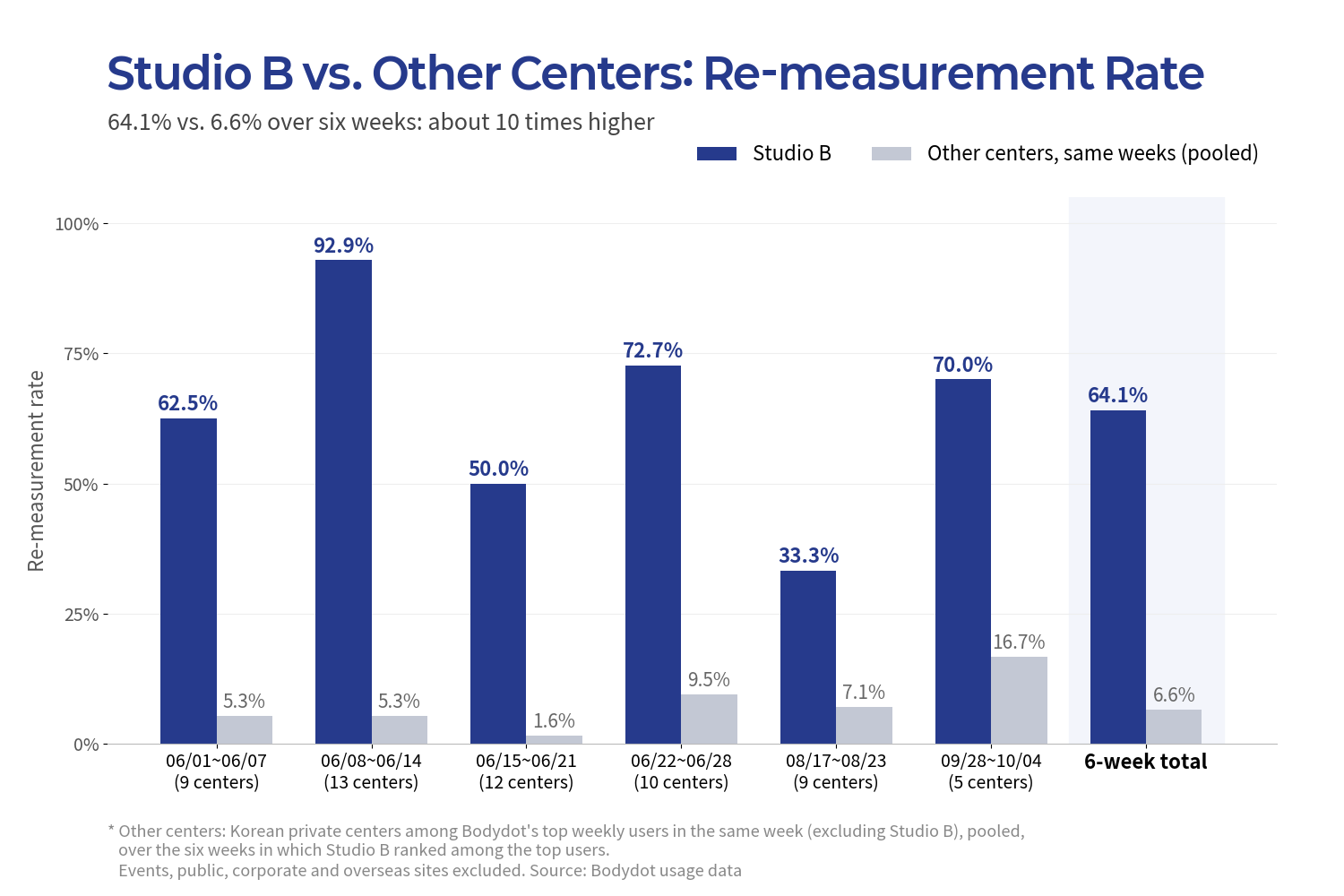
Center that re-measured most | 78 | 64.1% |
Over the 18 weeks, centers in Korea recorded 234 re-measurements. Of these, 127, or 54.3%, came from just four centers.
Many centers measure often, but only a few re-measure their members.
How Are Centers Using Their Body Analyzers?
There are three main ways centers use a body analyzer. They differ in when they measure and whom they measure.
Type | Usage pattern | When they measure | Limitation |
Batch type | Measures dozens of members at once within 2–3 weeks | Openings, events | Often ends after a single measurement |
New-member type | Measures 10–16 new members every week, with almost no re-measurement | First consultation, orientation | No chance to show members how they’ve changed |
Re-measurement routine type | 50–90% of measurements are re-measurements of existing members | On a set schedule | Lower share of new-member measurements |
Of the three, only the re-measurement routine type steadily builds up member records.
With the other types, results are used once at the first consultation and that's it, leaving no record to compare for each member.
Even among Bodydot's top users, most centers were the new-member type, and re-measurement routine centers could be counted on one hand.
So how do centers that have built a re-measurement routine actually operate?
How Do Centers with a Re-measurement Routine Use Their Body Analyzers?
Centers with a re-measurement routine use their results for both member management and marketing.
Studio B: No. 1 in Korea for Re-measurement, and It Doesn't Stop at Sending the Report
Over the 18 weeks, Studio B recorded the most re-measurements of any center in Korea.
Of its 78 measurements, 50, or 64.1%, were re-measurements of existing members.
What makes Studio B stand out is what happens after the re-measurement.
Instead of simply sending members their results report, the studio also sends a message that explains each result one by one.
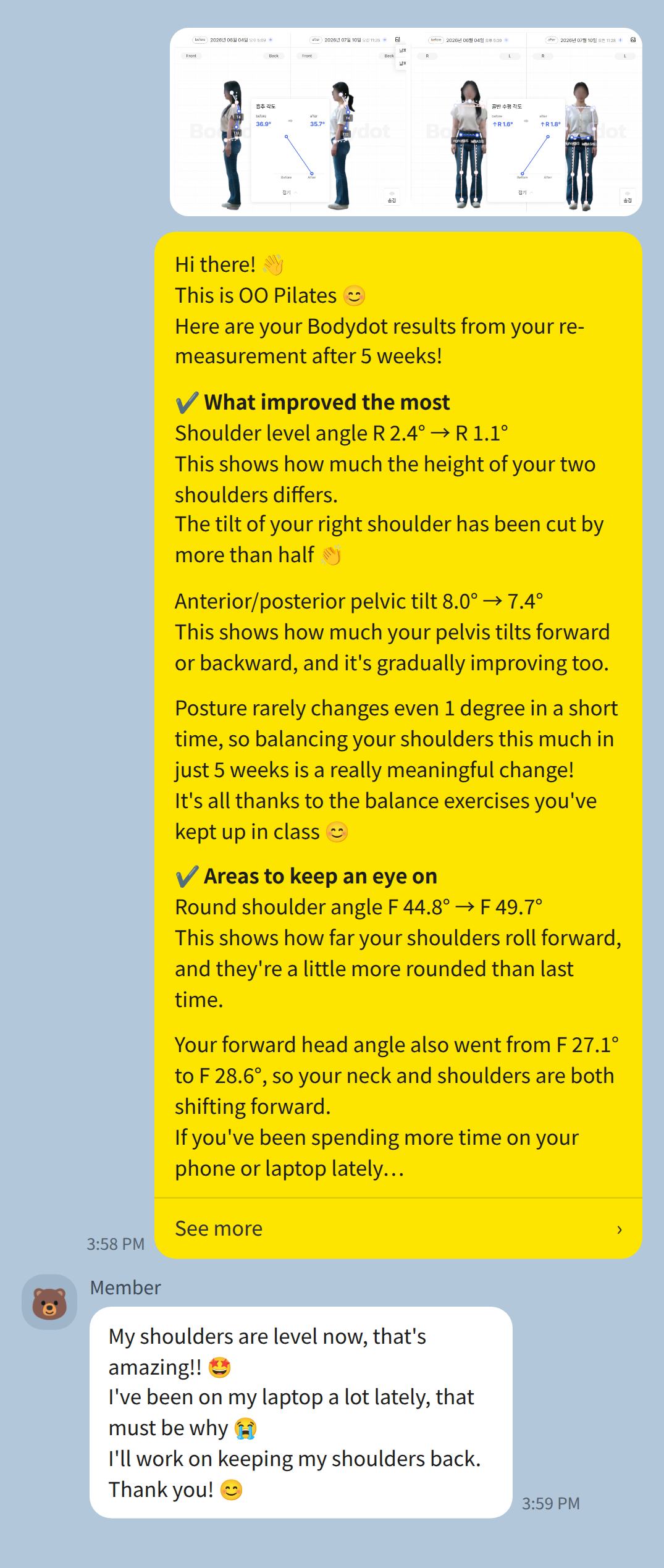
Message section | What it covers |
What improved, with numbers | The metric that improved most compared with the previous measurement, and by how much |
What the metric means | What the metric shows about the body, and which daily habits it relates to |
Why the change matters | Points out that posture rarely shifts even 1 degree in a short time, to show how meaningful the member’s change is |
Areas for improvement | Metrics that still need work, and the discomfort they may cause if left as they are |
Next steps | What to focus on next, and what changes to expect with consistent exercise |
회원 입장에서는 숫자 하나가 "내 몸이 이만큼 좋아졌고, 다음엔 여기를 신경 쓰면 된다"는 설명으로 바뀝니다.
실제로 메시지를 받은 회원은 "자세히 설명해 주셔서 감사하다, 말씀해주신 부분 신경 쓰면서 꾸준히 운동하겠다"고 답했습니다.
좋아진 점만 칭찬하지 않고 아쉬운 점과 다음 목표까지 짚어주기 때문에, 재측정이 다음 운동으로 자연스럽게 이어집니다.
B필라테스는 이 메시지를 인스타그램 하이라이트에도 모아 두고 있습니다.
회원 개인에게 보낸 관리 메시지가 그대로 센터의 신뢰를 보여주는 콘텐츠가 됩니다.
For members, a single number turns into an explanation: "My body has improved this much, and next I should focus on this."
In fact, one member who received the message replied, "Thank you for explaining it in such detail. I'll keep the points you mentioned in mind and keep working out consistently."
Because the studio doesn't just praise what improved but also points out what still needs work and sets the next goal, each re-measurement leads naturally into the next phase of training.
Studio B also collects these messages in its Instagram highlights.
A personal follow-up message sent to one member becomes content that shows the trust the center has built.
Studio M: A Center That Carefully Tracks Every Member's Progress
Studio M consistently tracks each member's progress across multiple measures.
The studio's Instagram regularly features members' progress records.
Beyond posture before-and-afters, it records exercise form, grip strength, and body circumference for each member.
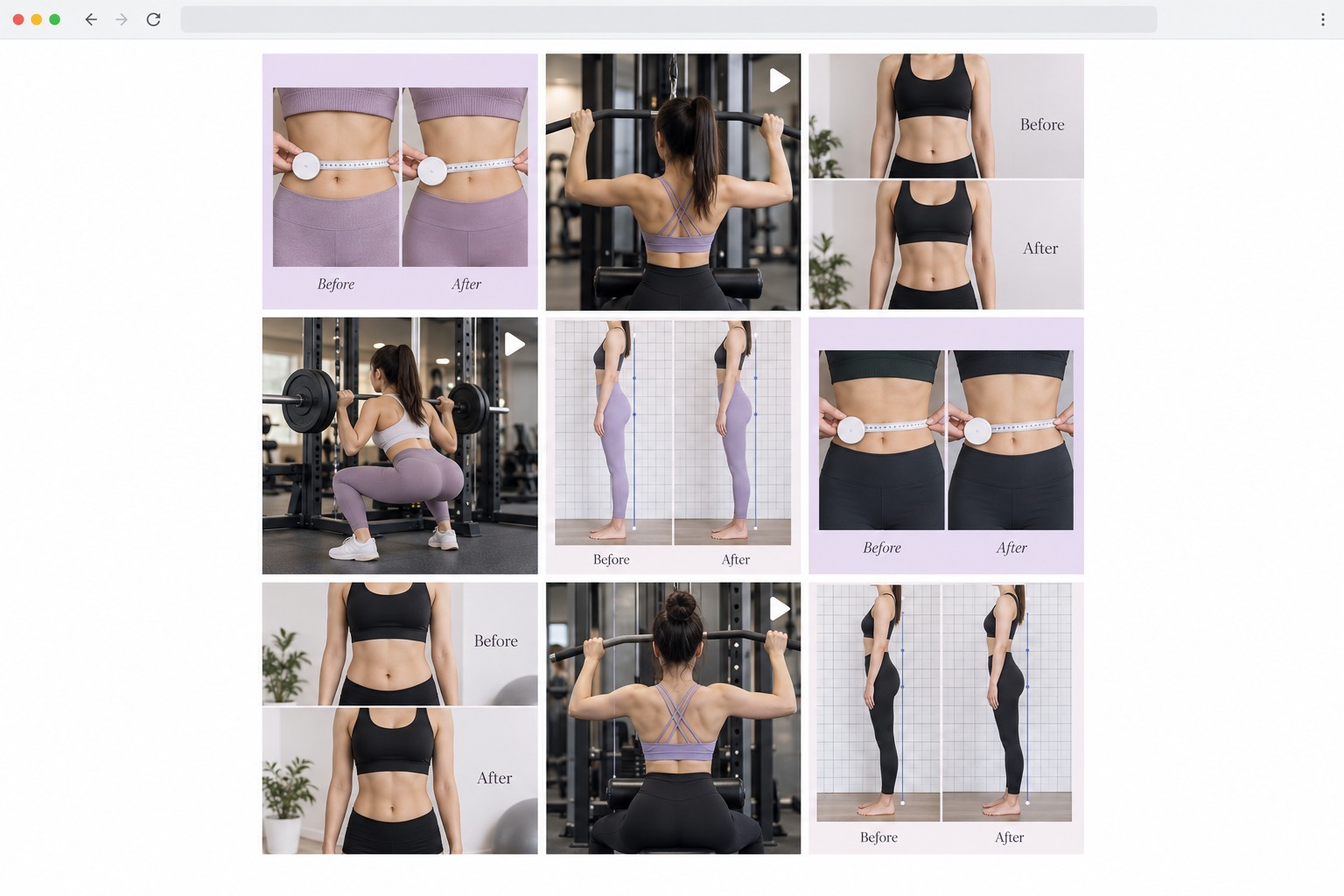
What’s recorded | What it shows |
Posture | How much alignment and left-right balance have changed |
Exercise form | How much more correctly the same movement is performed |
Grip strength | How much strength has increased |
Body circumference | How the body’s shape has changed |
Records like these can't be created from a single measurement.
Only by recording a member's starting point and measuring them again over time can you show how much they've changed.
For Studio M, posture measurement isn't a separate event but one of many measures that fill out each member's record.
Its Bodydot usage data also shows re-measurement becoming part of its routine.
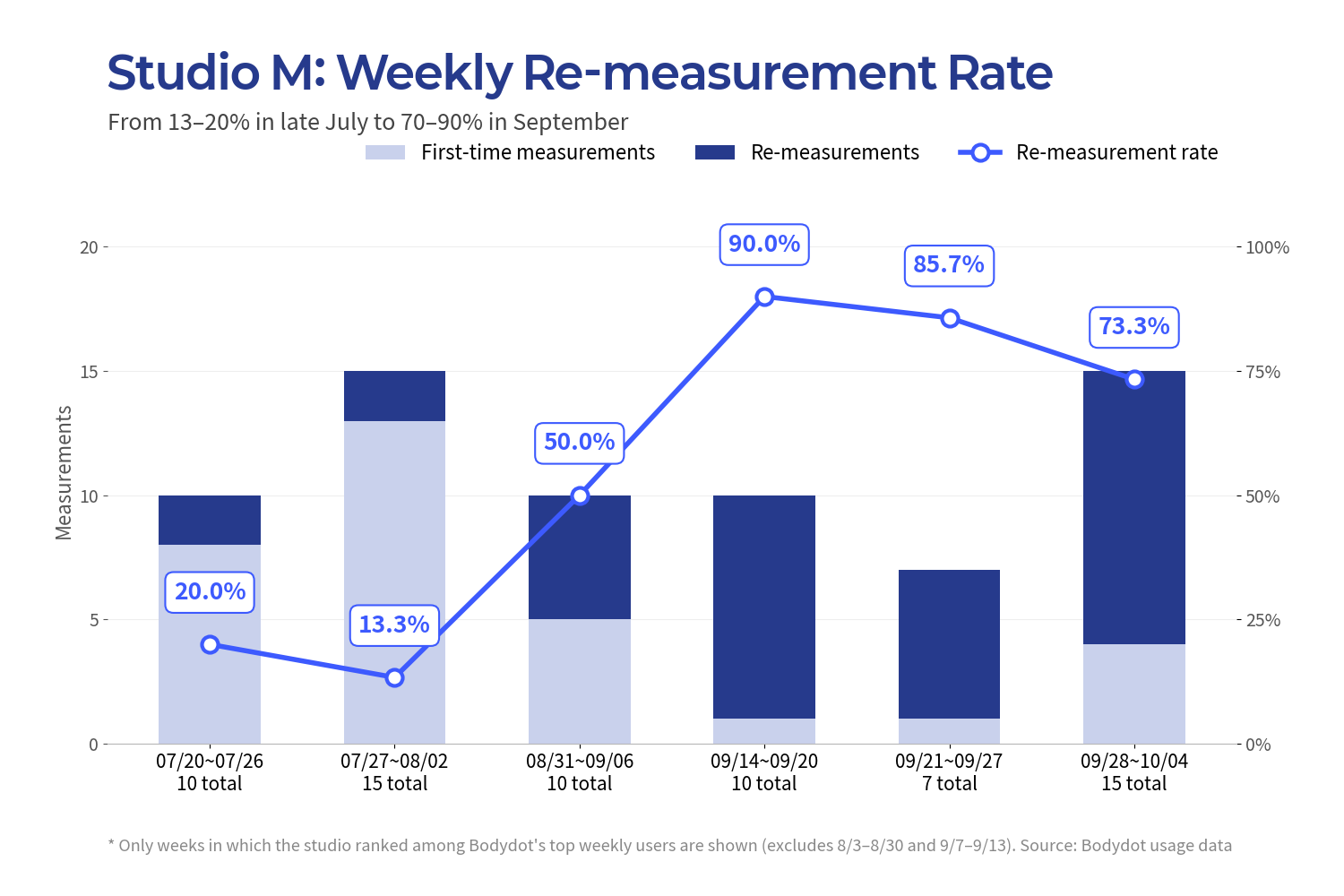
Studio M's re-measurement rate, which was 13–20% in late July, rose to 73.8% in September, with 31 of its 42 measurements being re-measurements.
While new members continued to be measured every week, the share of re-measurements of existing members grew significantly.
Because the studio records so many measures, members can see changes not just in their posture but across their whole body.
How Does Re-measurement Help with Member Management?
재측정은 회원이 운동을 이어가고 있다는 신호이자, 다음 상담의 근거가 됩니다.
한 번 측정한 회원이 몇 주 뒤 다시 측정했다는 것은, 그때까지 센터에 꾸준히 다니고 있었다는 뜻입니다.
재측정 결과는 "그동안 이만큼 달라졌다"를 숫자와 사진으로 보여줍니다.
그 근거가 있으면 다음 목표를 세우는 대화도, 재등록 상담도 훨씬 자연스러워집니다.
앞의 두 센터가 이를 잘 보여줍니다.
B필라테스는 재측정 결과를 회원 한 명 한 명에게 해석해 보내고, M센터는 체형과 함께 여러 항목을 기록으로 쌓아갑니다.
재측정은 측정을 한 번 더 하는 일이 아니라, 회원과의 관계를 이어가는 과정입니다.
Re-measurement is a sign that a member is sticking with their training, and it gives you a basis for the next consultation.
If a member measured once comes back for another measurement a few weeks later, it means they've been coming to the center consistently.
Re-measurement results show, in numbers and photos, how much a member has changed.
With that evidence, conversations about the next goal and about renewing a membership both become much more natural.
The two centers above show this well.
Studio B interprets re-measurement results for each member individually, while Studio M builds up records across many measures alongside posture.
Re-measurement isn't just taking one more measurement. It's how you keep the relationship with your members going.
How Can You Build a Re-measurement Routine with Bodydot?
The key to building a re-measurement routine with Bodydot is setting the next measurement date in advance.
Challenge for centers | How Bodydot helps |
It’s hard to explain changes to members | Places the previous and current measurements side by side and shows the change in each metric as a graph |
It’s hard to see at a glance what has improved | Improved metrics are marked “Improved” in the results comparison table |
Preparing materials to send to members takes time | Save the comparison screen as an image and send it right away (with or without the date) |
Each trainer consults differently | Measurement results based on the same standard let anyone provide consistent consultations |
Simply match your re-measurement schedule to your center's program cycle. Below is an example based on an 8-week program.
When | What to do |
First visit | First measurement, set goals with the member, schedule the next measurement date |
Week 4 | 1st re-measurement, share what has improved and what to focus on |
Week 8 | 2nd re-measurement, review progress and discuss membership renewal |
After that | Set the next goal and repeat on the same cycle |
Key Takeaways
- To track and manage members with a body analyzer, re-measurement is essential.
- Studio B sends each member a personal interpretation of their results, and 64.1% of its measurements over 18 weeks were re-measurements.
- Studio M records posture, exercise form, grip strength, and body circumference together, and its re-measurement rate rose to 73.8% in September.
- When you set re-measurement dates in advance, measurement becomes a member management routine rather than a one-time event.