A first consultation is the meeting a prospective member has before formally joining a facility, and whether trust is established in that single meeting is what mostly determines whether they sign up.
After visiting a few facilities, why choose this one?
Most prospective members don't decide after visiting just one place. They tend to check out two or three nearby facilities, or research them online, before finally sitting down for a consultation. By that point, the question in their mind is clear: "What's actually different about signing up here? The trainer at the last place said pretty much the same thing."

A trainer talks about their experience and certifications, and explains what's good about the program. But from the member's side, a trainer at another facility likely said something very similar. Spoken explanation doesn't stand out from what any other facility is saying.
Why doesn't spoken explanation carry enough weight?
This isn't a matter of a trainer's speaking skill. Spoken explanation is inherently unverifiable — that's a structural limitation, not a personal one. A statement like "your posture isn't great" is just a trainer's subjective observation, and the member has no way to judge whether to believe it beyond their overall impression of the trainer. Experienced or new, a trainer has no way to prove "why here" through words alone.
What a first consultation actually needs is evidence
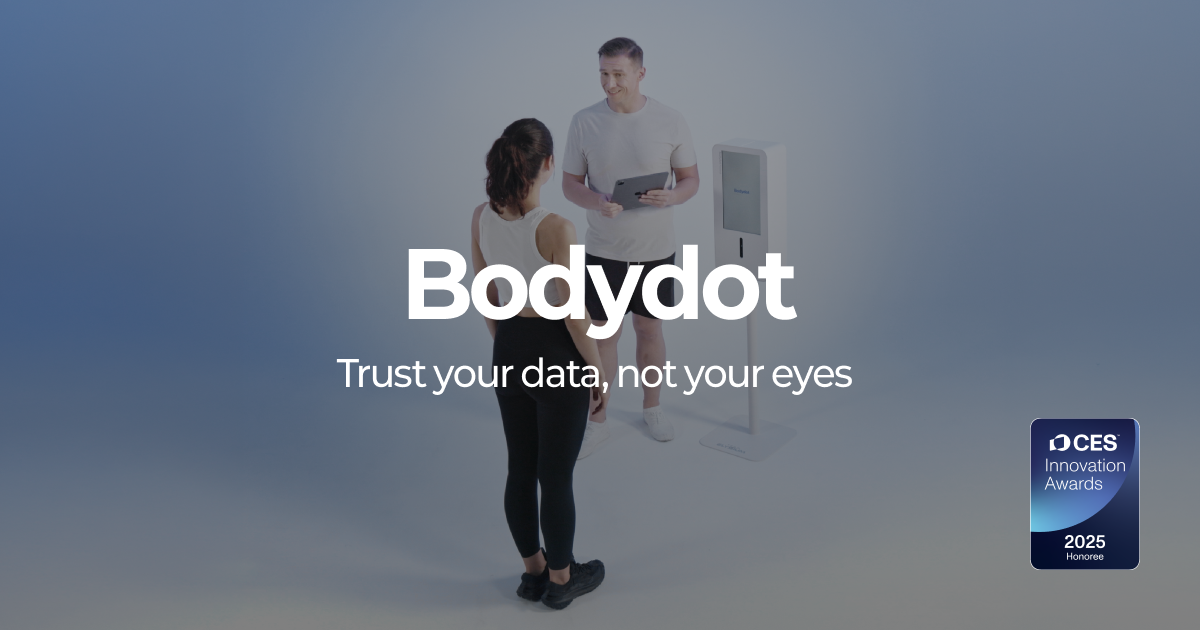
Trust comes from evidence, not claims. Bodydot shows a member their own posture and alignment data visually in 30 seconds. Instead of "your posture isn't great," the member sees a concrete finding on screen — "your left shoulder sits 2 degrees lower, and your pelvis is tilted forward." At that moment, the consultation shifts from "trust me" to "see for yourself."
Category | Spoken Consultation | Data-Backed Consultation |
Basis | Trainer's subjective observation/experience | Visual data across 40 measurement items |
Verifiability | No way for the member to check | Visible on screen immediately |
Differentiation from other facilities | Barely distinguishable | Few facilities have adopted it — a differentiator |
Member's reaction | "I guess so" | "Wait, is that really my condition?" |
Link to next visit | Weak grounds for persuasion | Before/after comparison flows naturally into renewal |
How the first consultation itself actually changes
A conventional consultation spends a large share of its time on a trainer observing and describing things verbally. With Bodydot, that order flips. Measurement is done within the 30 seconds a member spends in front of the device, and the trainer spends the rest of the time using the report to explain why a given program is necessary. The prospective member ends up remembering this facility as the one place where they saw their own condition with their own eyes before the consultation was even over.
FAQ
How is Bodydot used in a first consultation?
When a prospective member arrives, a 30-second scan produces a posture and alignment report first, which is then used as the basis for explaining a program.
Can a new trainer get the same result?
Yes. Since the AI handles the measurement and analysis, the same quality of visual evidence is available in the consultation regardless of a trainer's experience.
Can trust be built in a remote consultation too?
Yes — results can be shared online through the cloud-based software, so the same data can be used in a remote consultation as well.
How accurate is the data?
Bodydot achieves 97.0% accuracy across 40 measurement items, based on an AI model trained on 165,000+ verified data points.
Doesn't the measurement take a long time?
No — the full process, from scan to exercise prescription, takes under 30 seconds, leaving most of the consultation for explaining and persuading.
Bottom line
Prospective members hesitate to sign up not because a facility is lacking, but because spoken explanation alone doesn't stand out from what every other facility says. The moment a first consultation shows objective, visible data, the reason to sign up here specifically finally becomes clear.