A body analyzer pays for itself through how a gym uses it, not through the device alone. Fitness centers typically recover the cost in two ways: using scan results to turn first consultations into personal training (PT) sign-ups, and running paid body analysis campaigns that bring existing and lapsed members back. This guide walks through both models with example numbers and a simple payback formula you can apply to your own gym.
Where the return actually comes from
A scan by itself doesn't generate revenue. What it does is give your trainers something concrete to talk about: a member's alignment, imbalances, and measurable starting point. That turns a consultation from "you should train with us" into "here's what we found, and here's the plan to fix it." The return comes from what happens after the scan — the PT program you propose, and the reason members have to come back and measure again.
The two models below show how that works in numbers. All figures are illustrative examples, not results from a specific gym or a forecast for yours.
Model A: PT conversion
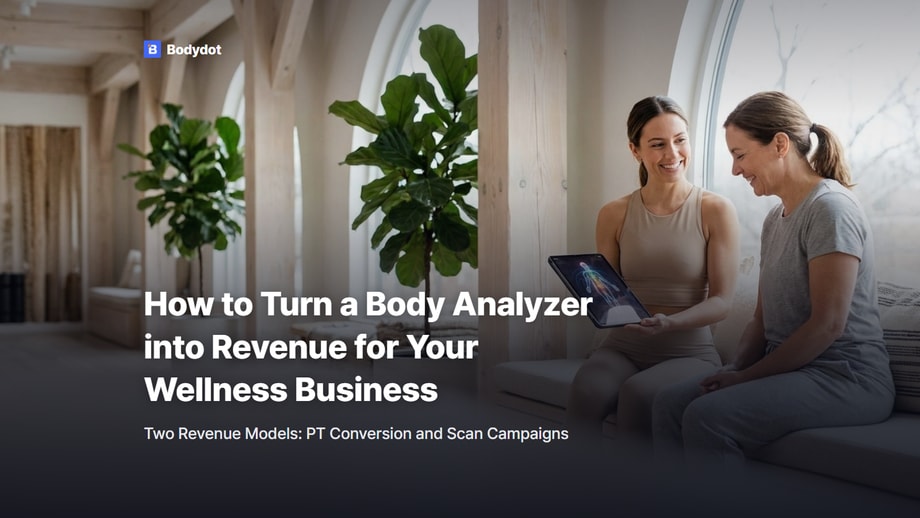
In this model, the scan is part of every first consultation and program proposal. The first scan is free or included in PT onboarding. The goal is to help members understand their own results — and see why a structured program makes sense.
Monthly PT revenue per member
- 3 sessions a week × 4 weeks = 12 sessions a month
- 12 sessions × $40 per session = $480 per member per month
If 15 new members sign up for PT in a month
- $480 × 15 members = +$7,200 in PT revenue that month
This is revenue for that month only, before trainer pay or commissions. It doesn't assume long-term retention or guarantee any number of sign-ups.
Model B: Body analysis campaigns
In this model, you offer a paid, in-depth body analysis to existing, former, and inactive members — with a free results consultation. It creates a reason to come back and an opening for a PT conversation.
Campaign revenue
- Offer: in-depth body analysis for $10, free results consultation
- 20 members a week × $10 × 4 weeks = +$800 a month
This is scan revenue only. Any PT sign-ups that follow are counted separately, not added on top of the scan revenue here. (Using 52 weeks ÷ 12 months instead of 4 weeks gives about $867 a month.)
A simple campaign flow
- Announce — send a short message to existing and lapsed members
- Book the scan
- Results consultation
- PT proposal
Example message:
[Gym name] It's been a while — check your posture and body alignment. In-depth Bodydot body analysis for $10, with a free results consultation. Book: [phone/link]
Before sending, check who you're allowed to message and the local rules for marketing messages in your area.
How long does payback take?
Payback period is simple: investment cost ÷ monthly contribution. Monthly contribution is the revenue the analyzer drives each month, minus its running cost.
Using the examples above, here's how the monthly revenue the analyzer drives changes with your operating approach:
Operating approach | Example monthly revenue |
Campaign only | $800 |
Campaign + one PT member a month | $800 + $480 = $1,280 |
The same investment comes back much faster when scans consistently turn into PT programs. In this example, adding just one PT member a month raises monthly revenue by 60%. That's why the PT conversion step matters more than the scan price.
These figures exclude taxes, trainer pay, commissions, and other running costs, so they are not net operating profit. Treat them as a starting point, not a promise.
Curious how payback would work for your gym? Investment cost depends on your setup and region. Contact us, and we'll walk through the numbers with your gym's real figures.
Run the numbers for your own gym
Replace the example values with your own:
- Your PT price per session and how many sessions a typical member books per month
- How many first consultations you run each month, and roughly how many become PT sign-ups
- What you'd charge for a scan campaign — or whether you'd offer it free as a lead generator
- How many existing or lapsed members you could realistically reach each week
- Your local exchange rate, if you're buying in a different currency
- Trainer pay and commissions, if you want to move from revenue toward profit
When a body analyzer won't pay off
Being honest about this saves you a bad purchase. ROI is unlikely if:
- You scan but don't follow up. If results are handed over without a consultation, the scan never turns into a program.
- Your business is mostly open-gym memberships with few one-on-one consultations or PT sales.
- Nobody owns the campaign. Re-engagement campaigns need someone to send messages, book scans, and run consultations.
- You never re-measure. Without follow-up scans, members can't see progress, and you lose the reason for them to come back.
FAQ
How does a body analyzer make money for a gym?
Mainly in two ways: scan results support first consultations that lead to PT sign-ups, and paid body analysis campaigns bring existing and lapsed members back while opening a PT conversation.
How do I calculate the payback period for a body analyzer?
Divide the total investment by the monthly contribution — the monthly revenue the analyzer drives minus its running costs. Since investment cost depends on your setup and region, contact us to calculate it with your gym's real figures.
Should the first scan be free?
Many gyms make the first scan free or include it in PT onboarding, so it supports the consultation instead of adding a barrier. Paid scans work better for campaigns aimed at existing or lapsed members.
Are these ROI numbers guaranteed?
No. They are illustrative examples. Actual results depend on your gym's size, location, pricing, and how consistently you run consultations and campaigns.
How long does a Bodydot scan take?
About 30 seconds from scan to exercise prescription, measuring 40 items with 97.0% accuracy.
Bottom line
A body analyzer's return depends on your operations. Used only as a measuring tool, it's a cost. Used as the basis for consultations, PT proposals, and re-engagement campaigns, it can pay for itself — and the more consistently scans turn into PT programs, the faster that happens. Start with your own numbers, and be honest about whether your gym will follow up on every scan.